Entertainment is one of the loudest corners of the web. Streaming reviews, celebrity news, movie recaps and fan communities all compete for the same clicks, and a lot of them look impressive from the outside. Big traffic charts, busy comment sections, a long list of "partners". If you run a small site in this space and you get an offer to swap links or buy a sponsored post, how do you tell a healthy publisher from one that only looks busy?
That question is part of a bigger shift in how SEO people evaluate websites. A few years ago, a single number such as Domain Authority often decided the whole conversation. Today more teams ask a second question: is this site's link profile trusted, or just large? A free Trust Flow checker is one of the quickest ways to get a first answer, and this article walks through how to use it with entertainment sites in mind.
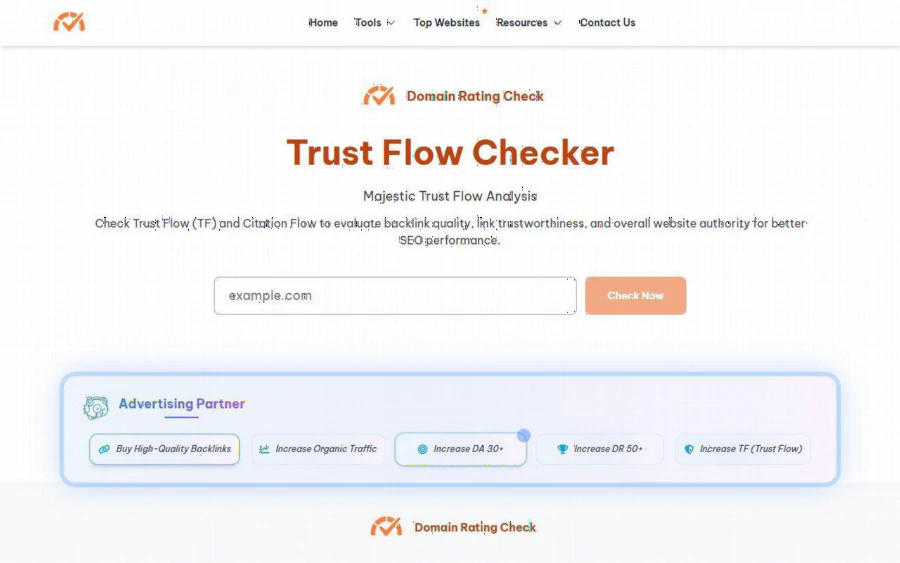
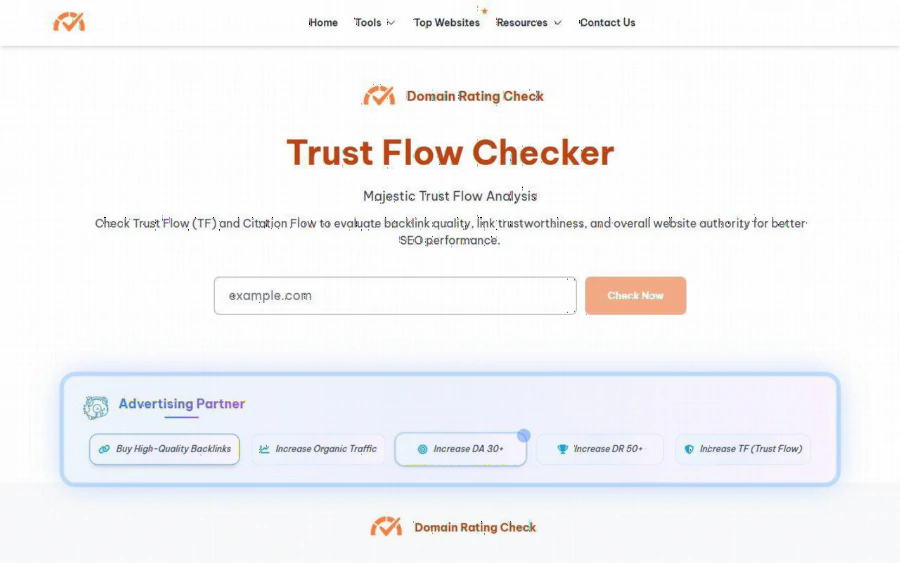
The Trust Flow Checker page on Domain Rating Check, showing the domain input box and the Check Now button
The trend: from one score to a trust picture
Entertainment sites grow fast. A viral recap or a trending show can send traffic up in a week. Their backlink profiles often grow just as fast, and not always in a clean way. Comment spam, scraped aggregator links and low-grade directory listings pile up quickly around popular topics.
That is why single-number thinking is losing ground. Domain Authority, as the DA page on the same site describes it, is a Moz metric that estimates the overall strength of a website, and a higher score suggests stronger authority. Useful, but it says little about the quality of the individual links behind it. Trust Flow comes from Majestic and answers a narrower question. According to the Trust Flow page, it measures the quality and trustworthiness of backlinks on a scale of 0 to 100, and it favors link quality over link quantity.
The practical trend is to read these numbers together instead of picking a favorite. The Trust Flow page says as much in its FAQ: TF describes link quality, DR and DA describe overall authority, and the page recommends using them together.
One situation: a movie blog owner with two offers
Imagine you run a small blog about film and TV, and two offers land in your inbox in the same week. One comes from a site that covers celebrity gossip and says it gets "huge reach". The other comes from a smaller site that reviews documentaries and indie films. Both want a link from you or are willing to give you one.
Here is how a Trust Flow check helps in this exact case.
1. Type each domain into the input box on the page and click "Check Now".
2. Read Trust Flow and Citation Flow side by side. Per the page, Citation Flow reflects backlink quantity and influence, while Trust Flow reflects quality.
3. Look at the gap. The page itself warns that a large gap where CF is much higher than TF may signal low-quality or manipulative links.
4. Check Referring Domains and EDU/GOV links. The results list these, along with Majestic Links, Subnets/IPs and Topical Trust Flow.
If the gossip site shows a high Citation Flow and a low Trust Flow, you have learned something that a traffic screenshot would never have told you. If the documentary site shows a modest but balanced pair of numbers, it may be the safer partner, even though it looks smaller.
Reading the numbers without over-reading them
The page gives a simple scale for Trust Flow:
- 0 to 10: very low trust, high spam risk
- 11 to 30: moderate trust
- 31 to 50: strong backlink quality
- 51 and above: very high trust and authority
For a niche entertainment blog, a score in the moderate band is not a red flag by itself. Small sites rarely sit in the top tier, and the page shows why. Its Top Websites table, titled "November 2026 Ranking", lists giants such as wikipedia.org with a Trust Flow of 96, and youtube.com and google.com at 100. A hobby site will never look like that, and it does not need to.
Two limits are worth saying plainly. First, the Trust Flow page is clear that Google does not use Trust Flow. It is a third-party metric, and its effect on SEO is indirect, through correlation with stronger backlink profiles. Second, a number is a snapshot. It cannot tell you whether the editorial team is careful, whether the site covers your audience's interests, or whether its readers actually click.
Topical Trust Flow: does the site really cover your subject?
Entertainment is a wide label. A site about anime, one about football highlights and one about celebrity fashion all count, yet a link from one may mean little on another. The results on the Trust Flow page include Topical Trust Flow, which, as the page explains, shows the top two topical categories linked to the site.
That is handy for a film blogger. If the site you are evaluating is tagged under arts or recreation categories and you review movies, the fit is plausible. If its top categories have nothing to do with your subject, the link may be trusted but irrelevant to your readers.
The Subnets/IPs figure is another quick signal. The page says higher diversity reduces PBN risk, because a site whose links all come from a handful of networks looks different from one with many independent supporters. Entertainment sites that live off aggregator networks often show this pattern first.
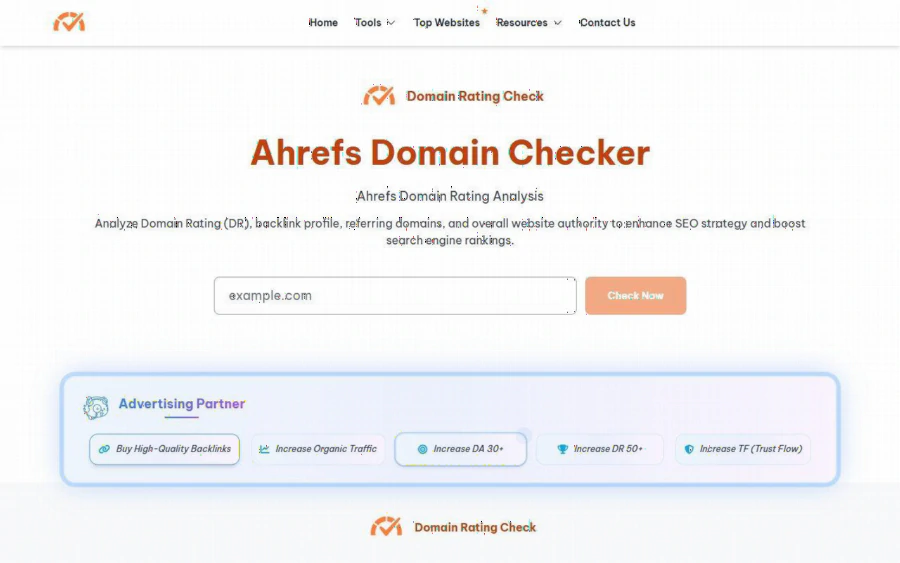
The Ahrefs Domain Checker page on the same site, offering Domain Rating, backlink profile and referring domains analysis
Pair it with DR and DA for a fuller view
Trust Flow alone is half a picture. The same site offers an Ahrefs Domain Checker that, according to its page, analyzes Domain Rating, backlink profile, referring domains and overall website authority. Used together, the two answer different questions: how strong is the domain overall, and how trustworthy are the links behind it?
The DA checker rounds this out. The page describes how to use it in five short steps: enter the domain, click "Check Now", let the tool analyze available data to generate estimated Moz-style metrics, view results such as Domain Authority, Page Authority, Moz Rank, Moz Links, Moz Trust and Moz Spam Score, then use the insights to identify strengths and weaknesses. Note the word "estimated" on that page. These are estimates, not official Moz figures, so treat them as a quick screen rather than a final verdict.
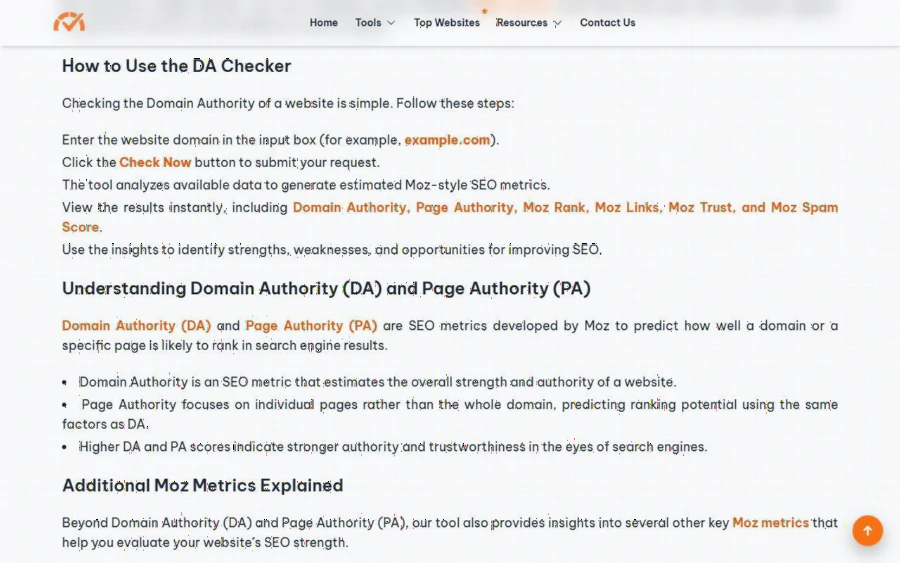
A section of the DA checker page explaining how to use the tool and what Domain Authority and Page Authority mean
A simple routine for a small entertainment site might look like this:
1. Run the Trust Flow check first, since it exposes link quality problems fastest.
2. Run the DR and DA checks next to see overall strength.
3. Compare the numbers across two or three candidate sites, not just one.
4. Open the site itself and read three recent articles. Numbers never replace this step.
Strengths, limits and who should skip it
What the tool does well is speed and simplicity. There is one input box, one button, and the metrics are explained in plain language on the same page. That makes it friendly for site owners who are not full-time SEO specialists.
The limits are also real. The page does not state usage limits such as a daily check cap, and it does not explain how often the Majestic data refreshes. There is no stated information about how brand-new domains are handled, which matters in entertainment, where new fan sites appear all the time. The page also carries an "Advertising Partner" block with promotional banners for paid services, so read it as a free utility with sponsors, not a neutral research lab.
Who should use it? Bloggers, small publishers and marketers who need a quick sanity check before agreeing to a link swap or a sponsored post. Who should not rely on it alone? Anyone making a large budget decision. For that, combine several data sources and manual review.
How to start today
Pick two sites you have been considering for a partnership. Open the Trust Flow page, enter the first domain and write down Trust Flow, Citation Flow, Referring Domains and the top topical categories. Repeat for the second. Then compare the gap between TF and CF, and ask whether the topical fit matches your audience.
If one site has a tidy, balanced profile and the other has a big gap, you already have a reason to ask more questions before you say yes. It takes about two minutes, it costs nothing to try, and it keeps the glamour of an entertainment brand from making the decision for you.